Product overview
FleetRoutIQ explores how a field-service organization can manage vehicles and review driver-reported locations across a web control center and an Android app. It is a working local-development prototype, not a deployed production service. The public showcase contains documentation and demonstrations rather than application source code.
Product screenshots
Web control center
Android app
System architecture
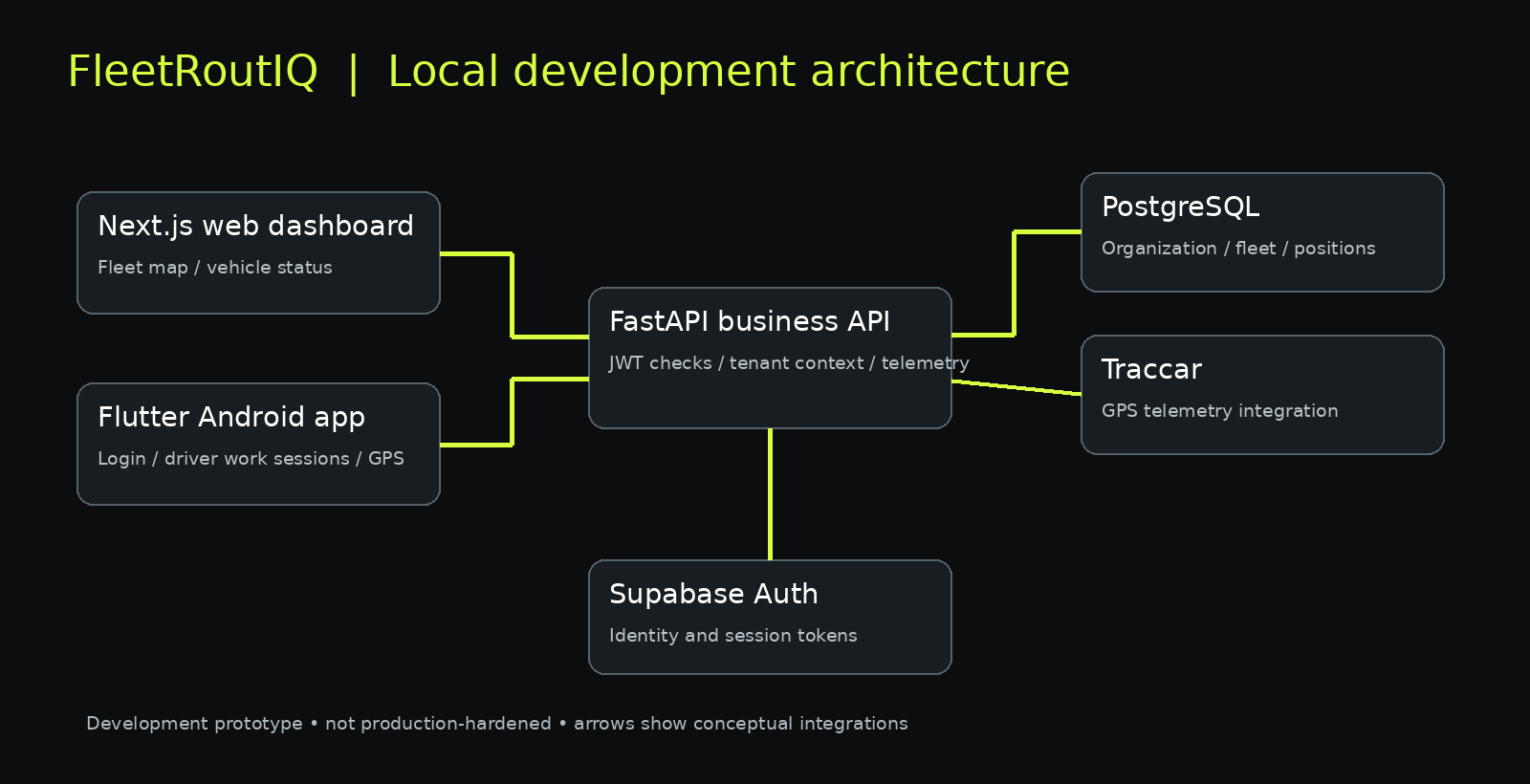
The Next.js dashboard and Flutter Android app use a FastAPI business API. Supabase Auth provides identity, while PostgreSQL stores organizations, memberships, vehicles, work sessions and telemetry. Traccar is a separate GPS integration with its own development database. Docker Compose orchestrates the local services; Redis is provisioned but is not evidence of completed caching or background jobs.
Functional flow
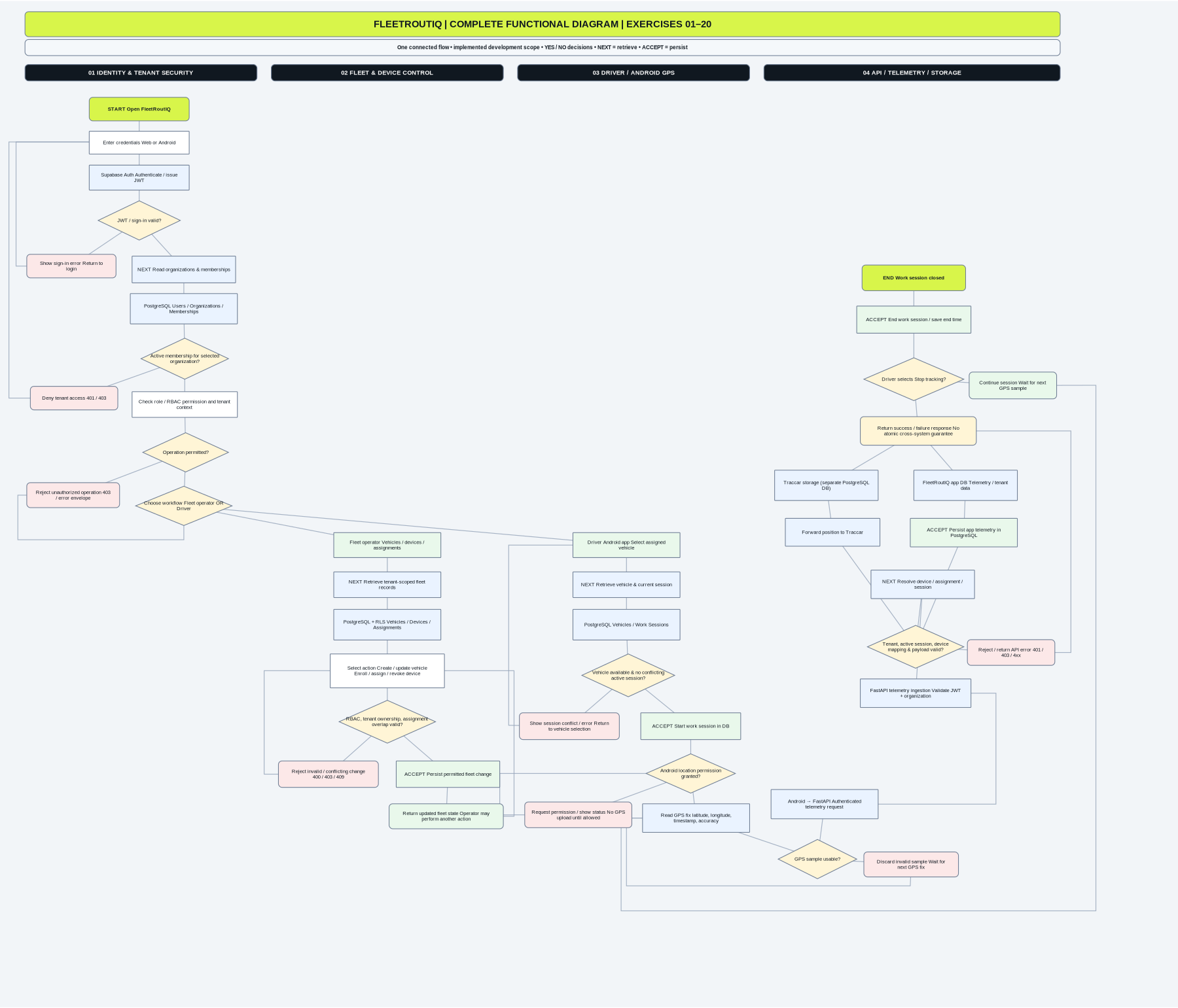
The functional diagram is a historical design artifact from exercises 01–20. The web map was completed afterward; this drawing is not a claim that every depicted workflow is implemented.
Implemented in local development
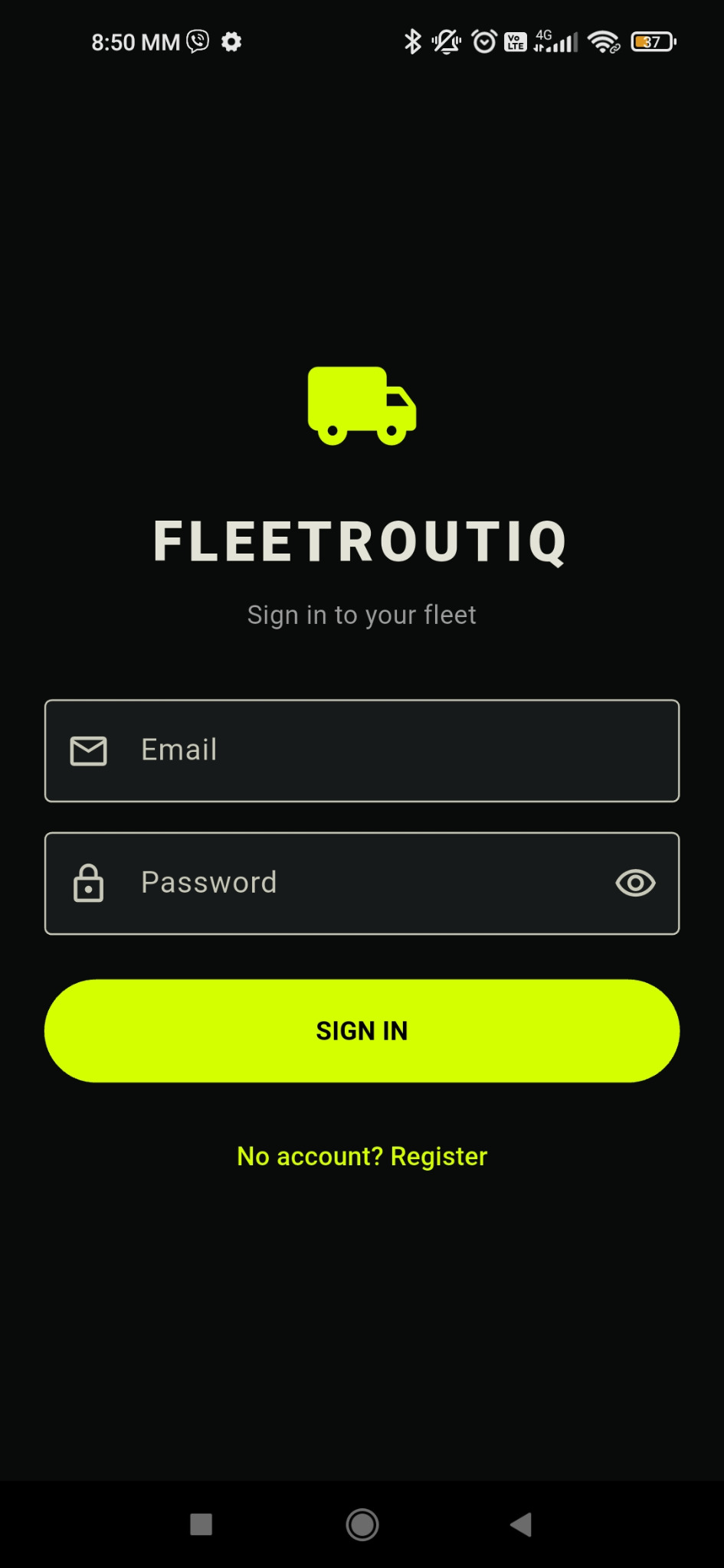
- Authentication: Supabase email/password sign-in on web and Android, with authenticated FastAPI requests.
- Tenant-aware backend: organization selection, membership resolution and organization-scoped application data; PostgreSQL row-level security is part of the defense-in-depth design.
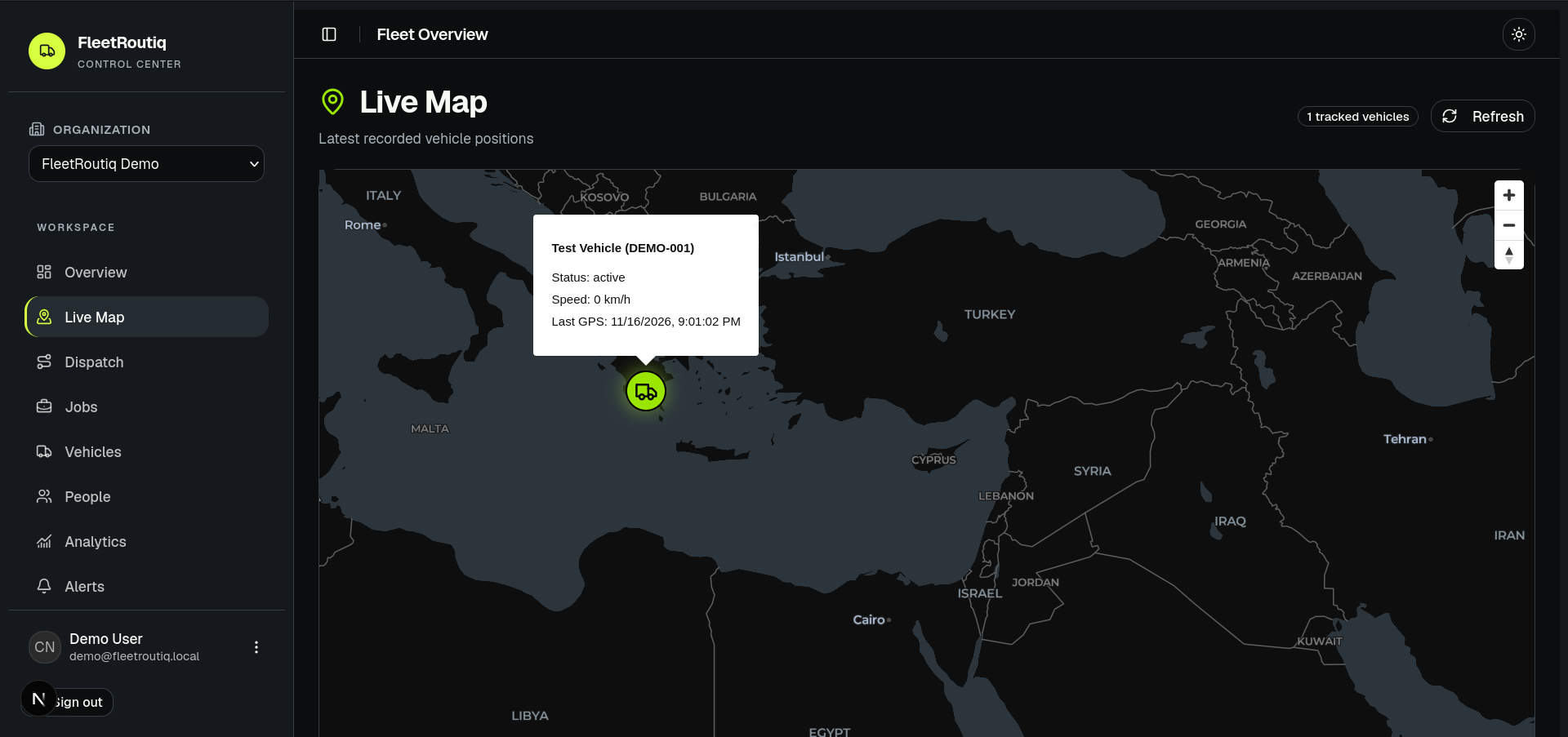
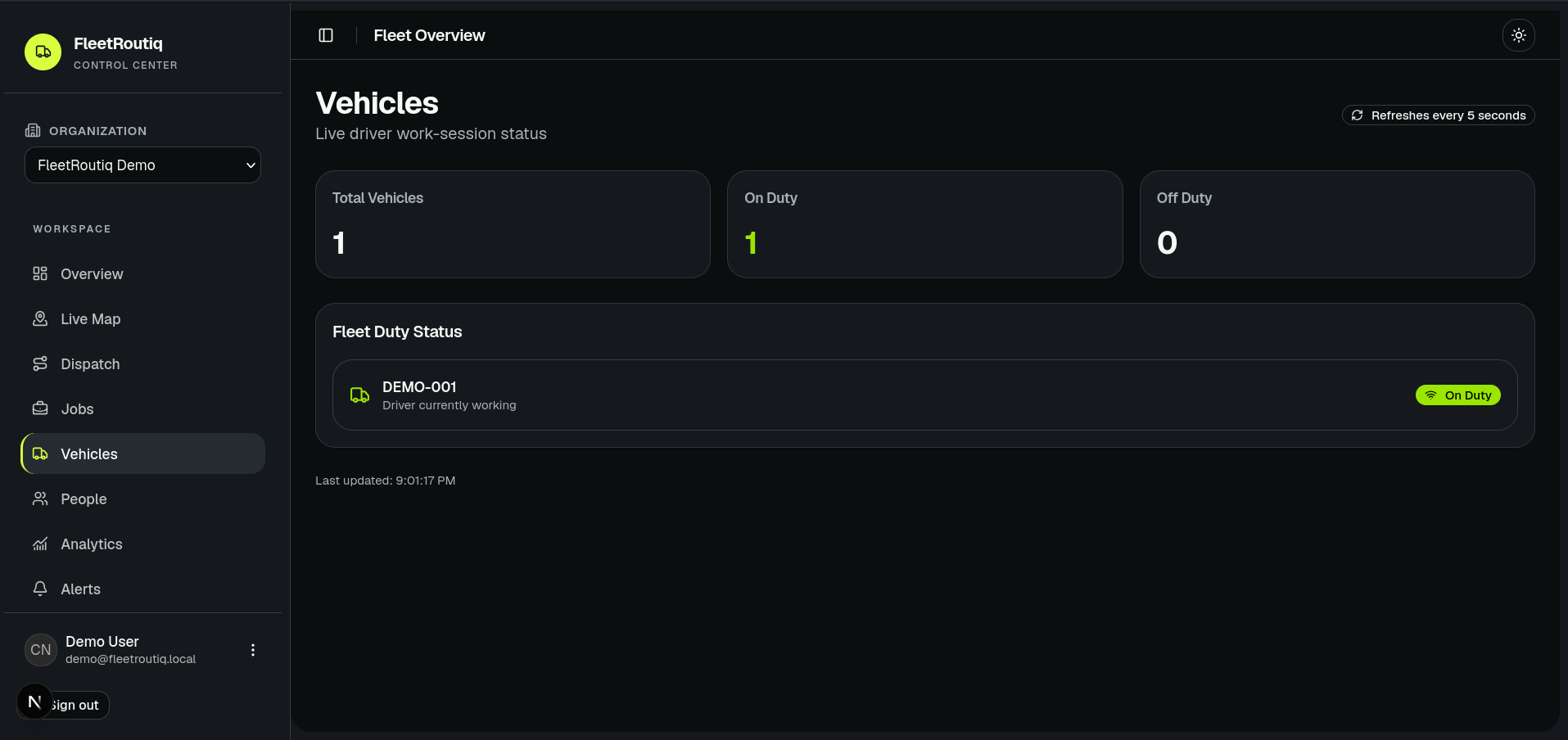
- Web dashboard: vehicle duty-status screen and a map displaying the last recorded GPS position, timestamp, speed and status.
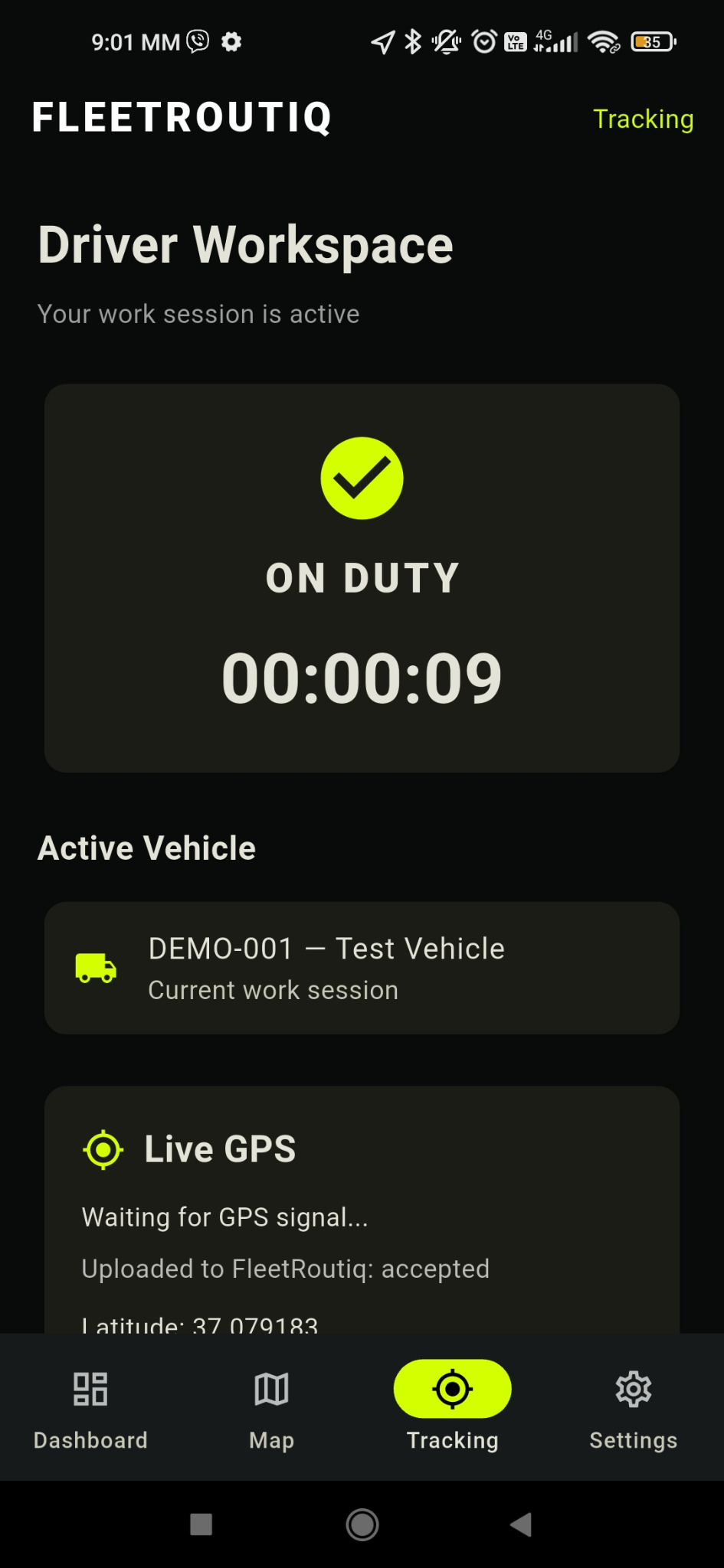
- Android app: authenticated driver workspace, vehicle selection, start/end work sessions, session timer and GPS upload status.
- Telemetry: phone GPS collection during work sessions, local API integration with Traccar and PostgreSQL persistence.
- Engineering stack: FastAPI, Pydantic, SQLAlchemy, Alembic, PostgreSQL, Next.js, TypeScript, Flutter, Dart, Supabase Auth, Traccar and Docker Compose.
Engineering decisions
Separate identity and business data
Supabase Auth manages login and tokens. A separate application PostgreSQL database stores business data. The backend must verify both user identity and membership for the selected organization; a client-provided organization identifier alone does not grant access.
Smartphone-first tracking
Using the driver's phone avoids dedicated GPS hardware in the prototype. It introduces battery, permission, network and background-execution constraints that require further validation.
Dedicated telemetry service
Traccar supports telemetry integration while FastAPI remains responsible for business authorization and organization-scoped data. Durable retries and reconciliation between forwarding and persistence are not yet implemented.
Testing and evidence
The project's historical Exercise 18 backend checkpoint recorded 112 passed, 2 skipped, 1 warning. Later development notes report successful local GPS collection, telemetry ingestion and passing tests, but the exact final count was not retained. These are historical development results, not a fresh CI run or a public source-code audit.
The screenshots document a demonstration organization and vehicle. The Android tracking screen includes a “Waiting for GPS signal” state, so it is not proof of uninterrupted background tracking. The map shows the latest known location, not continuous real-time movement.
Security and known limitations
Authentication, tenant scoping and RLS have been developed and exercised locally, but no production security audit is claimed. Remaining gates include mandatory device credential verification, trusted HTTPS for mobile traffic, review of RLS/tenant identity trust boundaries, location-data privacy and retention policies, and robust offline retry and background tracking.
The vehicle CRUD interface, complete user-facing RBAC, dispatch workflows, analytics, alerts, production deployment and iOS validation are planned or incomplete, not presented as shipped.
What comes next
Complete authorization hardening and device credential checks, improve offline GPS reliability, validate background tracking on real devices, and collect dated sanitized test evidence. The source repository remains private; this public portfolio showcases the documented system and its tradeoffs.