Watch the working demonstration
The video demonstrates the prototype workflow. The management dashboard is still under development and is not presented as a finished product.
Problem and solution
Small businesses spend time answering service questions and coordinating appointments. I built a browser-based voice assistant that connects conversational requests to FastAPI operations instead of merely generating text.
Architecture
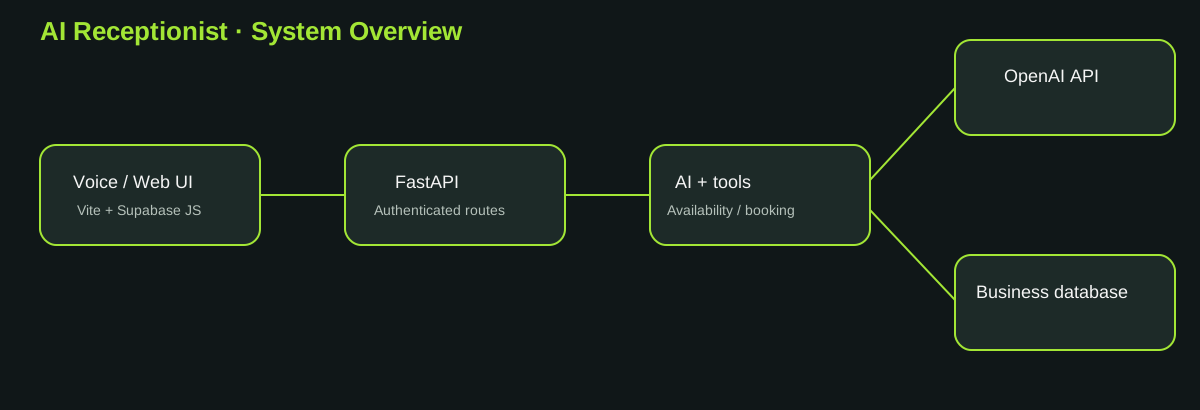
Stack: Python, FastAPI, Pydantic, SQLAlchemy, Supabase Auth, PostgreSQL-compatible persistence, Vite/JavaScript and OpenAI API.
Voice-to-booking workflow
- A customer starts a browser voice session and asks for a service and appointment.
- The assistant interprets the request and invokes structured tools such as
check_availabilityandbook_appointment. - Scheduling logic checks service duration, opening hours, closures, existing bookings and past-time restrictions.
- The booking path rechecks availability and uses a PostgreSQL advisory lock to reduce competing-booking conflicts.
- The assistant communicates the result through synthesized speech.
Engineering highlights
- Backend / AI integration: structured tool calls connect conversation to business operations.
- Scheduling integrity: operating hours, overrides and existing bookings are considered before accepting a slot.
- Authentication: Supabase bearer tokens map application users to associated businesses; broader isolation regression testing remains planned.
- Business workflows: appointment, customer, service, lead and call-related API modules.
Known limitations
- Voice response latency has sometimes been around 10–15 seconds in development; this is an observed issue, not a controlled benchmark.
- The dashboard requires UX polish and is not production-ready.
- Full tenant-boundary regression tests, migrations, retention policies and end-to-end performance measurement remain planned.
- Scheduling currently uses a fixed Europe/Athens timezone.
Next steps
Reduce latency, strengthen automated integration tests, complete privacy controls and improve the dashboard without overstating readiness.